Spec-Driven Development and the AI-Native SDLC: 2026 Analysis
2026-04-05 Personal Notes
https://youtu.be/mViFYTwWvcM?si=NCXHJjx91qqeUGTs
SDD; “How do you effectively convey what you want to build with an LLM”
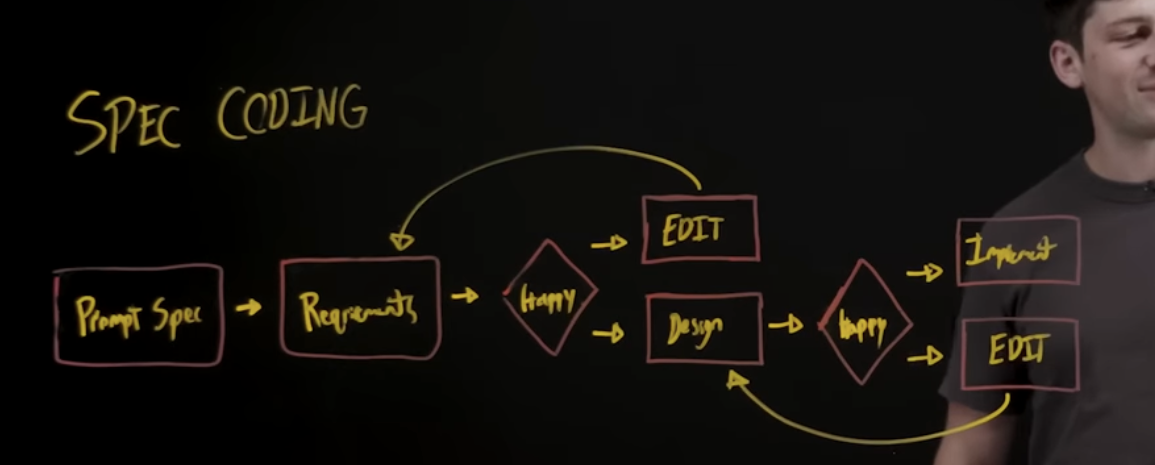
SDD Overview:
- Prompt Spec: contract
- Requirements - what and how to test, validate
- Approve
- Design doc (TODO w/ tasks)
- EDIT >> back to requirements
- happy/approve
- Implement
- EDIT >> back to design doc
- happy/approve
TRAD: code >> docs
TDD: test >> code >> docs
SDD: spec >> code (hybrid), on steroids)
Product Spec: much more detail; iterated doc together w/ engineering Lay out tasks, work in the same doc
Questions:
- How to merge in with Epics and ACs in JIRA? Do JIRA tickets still matter? What about UI designs? Failure behavior?
- How do we jointly iterate on the spec together? Async work?
- What about how best to use Pencil? Design tweaks?
- How do we ensure the Pencil designs match the code UI?
- Should we retroactively update the Pencil files based on the true UI code decisions?
OpenSpec:
The Big Picture: Three Paradigm Shifts
1. Code is no longer the source of truth — specs are
The specification becomes the primary artifact; code is derived from it. An arXiv preprint describes this as “fundamentally inverting traditional approaches.” Direct code edits become like editing binaries — technically possible but fighting the system.
2. The bottleneck moved from building to deciding
Andrew Ng suggests the dev-to-PM ratio could flip from 1 PM per 4-6 engineers to 2 PMs per 1 engineer. AI accelerates code generation so dramatically that deciding what to build is now the constraint.
3. Context engineering replaced prompt engineering
Andrej Karpathy, Gartner, and the broader industry declared “prompt engineering is out, context engineering is in.” The quality of AI output is bounded by the quality of structured context provided, not by clever prompts.
The Evolution: Vibe Coding → Plan Mode → SDD → Agentic Engineering
| Era | Interaction | Context | Limitation |
|---|---|---|---|
| Vibe Coding (2024-2025) | One prompt at a time | Implementation IS context | Breaks past ~500 lines, requirements drift |
| Plan Mode (2025) | AI drafts plan, human reviews | Tactical, doesn’t persist | Plans don’t survive execution |
| Spec-Driven Development (2025-2026) | Ongoing dialogue via specs | Specs as shared understanding | Enterprise adoption gaps |
| Agentic Engineering (2026) | Orchestrating agent swarms | Harnesses + specs + context files | Requires organizational transformation |
The Three-Month Wall (Vibe Coding’s Failure Mode)
GitClear’s 211M-line analysis: refactoring dropped ~60% from 2021-2024 while copy-paste rose ~48%. Vibe-coded projects follow predictable decay — rapid shipping (months 1-3), integration challenges (4-9), debugging overhead (10-15), delivery stalls (16-18).
METR research: apps built through unreviewed vibe coding are 40% more likely to contain critical security flaws.
The SDD Tools Landscape (2026)
| Tool | Approach | Notable Feature |
|---|---|---|
| Kiro (Amazon/AWS) | Full spec-driven IDE powered by Claude | EARS requirements format, GovCloud support, SageMaker integration ⚠ 2026-09: hands-on review found it over-specifies small work — see the counter-argument below |
| GitHub Spec Kit | Open-source toolkit (84.7K stars) | Supports 14+ AI agent platforms, 136 releases through Apr 2026 |
| OpenSpec | Incremental spec capture | Three-phase workflow (proposal → application → archival), brownfield-friendly |
| Tessl | Tests embedded in specs | Spec-to-implementation alignment via embedded validation ⚠ 2026-09: the only tool here aiming at spec-as-source, and the one carrying the inflexibility-plus-non-determinism risk; still in beta |
| Augment Code | AI-native coding with spec support | Comprehensive guides on SDD methodology |
30+ frameworks now power spec-driven development, from SpecKit and OpenSpec to GSD, Devika, and autonomous coding agents.
Role Transformations
Product Managers: From Documentation to Judgment
Naval Ravikant: “Vibe coding is the new product management.”
The PM role shifts from writing PRDs to:
- Framing problems clearly — the “What” and “Why” in SDD’s Discover phase
- Writing crisp acceptance criteria with enough precision for agents to understand
- Evaluating AI-generated output rather than specifying implementation details
- Directing agent swarms — deciding what to build next while agents build in parallel
Market signal: PMs who can prompt, evaluate, and ship AI-built products command $180-260K+ roles in 2026. Andrew Ng’s prediction of a 2:1 PM-to-engineer ratio reflects this shift.
As building becomes faster and cheaper, the backlog starves for fresh ideas if PMs are consumed with review. — InfoQ
Designers: Design-to-Code Becomes Real
- AI can now generate production-grade frontend interfaces from design specs (see: frontend-design skill pattern)
- The designer role shifts from pixel-perfect handoffs to defining design systems as constraints that agents enforce
- Tools like Kiro and specialized design agents turn Figma specs into working components
- Designers become quality validators of agent-generated UI rather than implementation specifiers
Engineers: From Writers to Orchestrators
Fortune magazine calls this “The Supervisor Class” — engineers who orchestrate AI agents rather than write code directly.
The PEV Loop (Agentic Engineering framework):
- Plan — decompose tasks, set boundaries, assign agent roles
- Execute — specialized agents work autonomously within constraints
- Verify — humans validate against acceptance criteria, security, architecture
Multi-agent orchestration in practice:
- Feature Authors (implementation)
- Test Generators
- Code Reviewers (style/security)
- Architecture Guardians (structural compliance)
- Security Scanners
Real-world results:
- Stripe: 1,000+ merged PRs weekly from agents
- Rakuten: 12.5M-line codebase in 7 hours
- TELUS: 500,000+ hours saved across 13,000+ AI solutions
- Zapier: 89% org-wide AI adoption, 800+ deployed agents
46% of code written by active developers now comes from AI (2026).
Context Engineering: The New Core Discipline
Context engineering is the practice of designing and managing structured input surrounding an LLM during a task — background knowledge, retrieved data, tools, and structured inputs that inform reasoning.
What It Includes
- CLAUDE.md / rules files — project-level context persisting across sessions
- Spec files — feature-level intent and constraints
- Architecture harnesses — cross-cutting concerns (security, performance, infrastructure)
- Role-specific harnesses — domain expertise encoded for agents
- Memory systems — persistent context across sessions
The Key Insight from Thoughtworks
“Understanding a system used to come naturally through hands-on work. Now, teams need new habits to retain that understanding. Context has become a skill, not a byproduct.”
Living specs preserve architectural context structurally rather than scattering it across chat threads.
Enterprise Adoption: The SpecFall Risk
The InfoQ article warns of “SpecFall” — the SDD equivalent of Scrumerfall. Adopting spec-driven workflows without changing how stakeholders actually collaborate creates a “markdown monster” generating layers of outdated documentation.
Key Enterprise Challenges
- Developer-centric tooling — specs in Git repos exclude PMs and analysts
- Mono-repo focus — enterprise features span multiple repos
- No separation of concerns — strategic decisions mixed with tactical tasks
- Unclear brownfield adoption — how to spec existing large codebases?
- Undefined collaboration patterns — who reviews what, when?
Practical Adoption Path
- Integrate with existing backlogs (Jira/Linear via MCP)
- Multi-repo orchestration — separate business context from technical specs
- Role-specific contributions — architects set constraints, agents apply them automatically
- Incremental brownfield — spec the area of change, not the whole system
- Living specs — specs update as agents implement, not as static documents
The Harness Governance Model
The most forward-looking concept: bugs aren’t code defects — they’re spec defects.
Two types of gaps:
- Spec → Implementation gap — spec was clear, code diverged → strengthen validation agents
- Intent → Spec gap — use case was missed → improve spec elicitation process
Quality engineering evolves from validating implementations to validating and improving the harnesses that guide agent execution. Each bug is feedback that improves future specifications.
Agent Swarms in Development (2026)
Claude Code launched agent teams (Feb 2026) — a lead agent plans and delegates to specialist agents that code, test, and review in parallel. Gartner predicts 40% of enterprise apps will deploy multi-agent swarms by year-end 2026.
How It Works
- Lead agent decomposes the spec into tasks
- Teammate agents work in isolated worktrees on subtasks
- Review agents validate output
- Human approves at key checkpoints
User reports consistently cite 5-10x productivity gains for properly scoped tasks.
Synthesis: The AI-Native SDLC
Intent (PM/Stakeholder)
    ↓ Discover Phase — articulate "What" and "Why"
Specification (living document)
    ↓ Design Phase — architect "How", decompose across repos
Task Breakdown (per-repo)
    ↓ Task Phase — agent-executable with verification criteria
Agent Swarm Execution
    ↓ PEV Loop — Plan, Execute, Verify
Implementation + Tests
    ↓ Harness feedback loop
Spec Refinement ← bugs feed back to improve specs
The flywheel: Better specs → better agent output → fewer bugs → spec improvements → even better specs. The harness carries accumulated wisdom forward.
Key Takeaways
- Specs are the new source code — invest in specification quality, not prompt cleverness
- Context engineering is the meta-skill — for PMs, designers, and engineers alike
- The 2:1 PM-to-engineer ratio is coming — deciding what to build is the bottleneck
- Agent swarms are production-ready — Claude Code teams, 5-10x productivity on scoped tasks
- Vibe coding has a place — prototyping, spikes, solo projects <3 months. Not production.
- Enterprise adoption is organizational, not technical — avoid SpecFall
- Quality engineering shifts upstream — validate harnesses, not just implementations
Sources (2026 only)
- Spec-Driven Development – Adoption at Enterprise Scale — Hari Krishnan, InfoQ (Feb 2026)
- Spec-Driven Development with AI: GitHub Blog — GitHub (2026)
- SDD Is Eating Software Engineering: 30+ Frameworks — Vishal Mysore, Medium (Mar 2026)
- Vibe Coding vs Spec-Driven Development — Augment Code (2026)
- 6 Best SDD Tools for AI Coding — Augment Code (2026)
- Agentic Engineering: Complete Guide — NxCode (2026)
- The Supervisor Class: How AI Agents Are Remaking Developers — Fortune (Mar 2026)
- Naval: “Vibe Coding Is the New Product Management” — Best PM Jobs (2026)
- Amazon’s IDE for Spec-Driven Development (Kiro) — Software Engineering Daily (Feb 2026)
- Claude Code Agent Teams: Swarm Mode — Sean Kim (Mar 2026)
- Beyond the Vibes: SDD at Agentic Conf Hamburg 2026 — Agentic Conf (2026)
- Thoughtworks: Spec-Driven Development — Thoughtworks (2026)
- PwC: Agentic SDLC in Practice — PwC (2026)
- Context Engineering Guide — CodeConductor (2026)
- Dex Horthy - Context Engineering for AI Coding Workflows — Research→Plan→Implement workflow, “dumb zone” concept, intentional compaction (YouTube, Apr 2026)
Counter-argument: a spec precise enough to generate software is a program
The thesis has been tried repeatedly under other names — waterfall requirements, UML and Model-Driven Architecture, BDD — and it failed each time. The failures were not tooling failures, which is what makes this attempt worth examining carefully rather than assuming the tooling is finally good enough.
The core objection is a dilemma. A spec loose enough for a human to read and maintain leaves the ambiguity that produces the wrong software. A spec tight enough to eliminate that ambiguity is source code, with worse tooling — no type system, no debugger, no refactoring support, and no compiler to tell you it is inconsistent. Every prior generation of spec-first tooling collapsed on this point, and generating from a natural-language spec does not dissolve it, it relocates it into a model’s interpretation.
The second objection concerns where requirements come from. They are discovered by building, not written down in advance. Offer Before Product - The Validation Sequence and Distribution-Based Product Development - Ship Landing Pages Not Code both argue that contact with reality generates the requirement. A process that front-loads articulation optimises the step that was never the source of truth.
There is also a reframing worth taking seriously, because it accepts the observation and rejects the prescription. If the bottleneck has moved to “articulating intent,” then the bottleneck was always product judgment — cheap code generation merely stopped hiding it. On that reading you do not need a spec-driven process. You need better product thinking, and the spec artifact is ceremony layered on top of a problem it does not solve.
Josh Elman - Product Management Is Still About Telling Stories sharpens the discovery side of this debate. Elman argues that the PM artifact is a repeatable user story and that cheap prototypes let discovery begin with build-and-play rather than a long specification. He says the prototype still has to cross into visual, UX, and engineering design before it becomes a working product. This analysis proposes the phase boundary: story plus prototype can lead product discovery, while a team chooses the precise constraints, tests, and specifications needed for production implementation.
The empirical tell. Watch whether spec artifacts survive the first generation cycle. The classic MDA failure was that code diverged from the model, the model stopped being updated, and the organisation ended up maintaining code while pretending to maintain specs. If teams are still regenerating from specs six months in — rather than editing generated code directly and letting the spec rot — the thesis is holding. Second tell: whether spec-first teams show genuinely lower defect rates, or the same rework relocated earlier and renamed.
2026-09 update — specs reduce review cost without replacing code ownership
Harness Engineering Is Not Enough - Why Software Factories Fail supplies a narrower pro-spec position. Dex Horthy proposes product review, system architecture, explicit program design, and vertical implementation slices before agent coding. The purpose is to make human code review shorter and clearer, not to eliminate it. Engineers still read every line and retain ownership of the maintained artifact.
This is evidence for spec-first work, not for spec-as-source. The missing bridge is Program Design Is the Missing Layer Between Architecture and Implementation: types, signatures, call structure, and implementation order translate architecture into code-sized decisions while the code remains authoritative in operation.
2026-09 update — the first hands-on negative evidence
Birgitta Böckeler tried Kiro, GitHub spec-kit and Tessl on real tasks and published what happened. This is a practitioner report, one evaluator, one or two tasks per tool, and she states her own bias plainly: she crafts specs before handing work to a coding agent and calls spec-first “definitely valuable in many situations.” The failures below come from someone sympathetic to the method.
Kiro over-specified a small bug. Asked to fix a bug she had used before as a benchmark, the requirements document produced 4 user stories with 16 acceptance criteria in total, including “As a developer, I want the transformation function to handle edge cases gracefully, so that the system remains robust when new category formats are introduced.” Her summary: a sledgehammer to crack a nut.
Spec-kit made review worse, not better. On a feature she sized as a 3-5 point story, it produced so many markdown files, repetitive with each other and with existing code, that her verdict was: “I’d rather review code than all these markdown files.” She never finished the implementation, and judged that plain AI-assisted coding would have got there in the same elapsed time with more control.
The control was partly illusory. Spec-kit runs a research step during planning, which correctly documented the existing classes the feature built on. The agent then ignored the note that these described existing code, treated the descriptions as new specification, and generated all of them again as duplicates. The opposite failure also showed up: over-eager compliance with one of the constitution articles.
The taxonomy worth adopting
Three implementation levels, which are usually collapsed into one word:
- Spec-first — a spec is written first and used for the task at hand.
- Spec-anchored — the spec is kept after the task completes and is used for the feature’s evolution and maintenance.
- Spec-as-source — the spec is the source file over time; the human edits only the spec and never touches the code.
Her finding: every SDD approach and definition she found is spec-first, and few strive past it. Where the maintenance strategy is left vague, it is usually left vague entirely. Kiro is spec-first with no described path to spec-anchored use. Spec-kit’s marketing aspires to living artifacts but it branches per spec, which makes the spec live for the change request rather than the feature. Tessl is the only one explicitly aiming at spec-as-source, marking generated files // GENERATED FROM SPEC - DO NOT EDIT, and it is still in beta at a 1:1 spec-to-file mapping.
This sharpens the counter-argument above rather than answering it. The dilemma bites hardest at level 3, and almost nothing is at level 3.
Specs versus memory bank
A separation worth keeping. Specs are task-scoped: they describe the functionality being created or changed, and are relevant only to the tasks that touch it. The memory bank is codebase-scoped: AGENTS.md, project.md, architecture.md, rules files, high-level descriptions relevant to every session. Kiro calls it steering, spec-kit calls it a constitution. Confusing the two produces either a bloated spec nobody reviews or a rules file that drifts.
The closing risk
Model-driven development is the direct ancestor here, and Böckeler worked on MDD projects early in her career. MDD’s specs were UML or a textual DSL, parsed by hand-built generators, and it never took off for business applications because it sat at an awkward abstraction level and imposed too much overhead. LLMs remove the parseable-language constraint and the custom generator. They also remove the tool support that a parseable language made possible — the checks that told an author their spec was valid, complete and consistent.
Her conclusion is the sharpest available statement of the risk: spec-as-source, and possibly spec-anchoring, may end up with the downsides of both — “Inflexibility and non-determinism.” She observed the non-determinism directly, generating code repeatedly from the same Tessl spec and iterating to make it specific enough to be repeatable, which is precisely the exercise the counter-argument above predicts.
Related Notes
- Agentic Software Factories - Operating Model and Evidence September 2026 — treats specifications as one factory control surface and tests spec-first practice against production architecture and long-horizon evidence
- AI + Product Management — specs as the new PM artifact; SDD reshapes how PMs define requirements
- Context Engineering — specs are context artifacts; context engineering is the core discipline of the AI-native SDLC
- Diana Hu - AI as an Operating System Not a Productivity Tool — “AI software factory” framing: specs + tests define success, agents iterate until tests pass. StrongDM as concrete example.
- Understanding Spec-Driven Development - Kiro, spec-kit, and Tessl — the hands-on critique this note’s counter-argument section rests on
- ProductSpec - Why a Product Intent Layer — a spec standard that sits above the coding agent rather than generating from it
- The Constraint Layer Is the Compounding Asset — the alternative to elaborate up-front specs: encode judgment as tests and lints instead
- Agent Harnesses — where spec artifacts live once the harness, not the spec, is doing the work
- Harness Engineering Is Not Enough - Why Software Factories Fail — supports upfront alignment while rejecting lights-off code ownership for complex, evolving systems
- Program Design Is the Missing Layer Between Architecture and Implementation — adds the technical layer between system architecture and implementation tasks